AFA News
Work of the Week celebrates World Photography Day
Celebrate World Photography Day with Colin Smith's camera obscura, Bow Lake.
Bow Lake
Colin Smith's Bow Lake is this week's Work of the Week. Smith turns his 1976 Boler trailer into a homemade camera obscura. Smith builds on location camera obscuras and creates projections that produce highly saturated, breathtaking imagery.
This work was acquired as part of the AFA’s Art Acquisition by Application program.
About World Photography Day
World Photography Day is the global celebration of all types of photography. Each year features an optional theme to focus on. The World Photography Day 2023 theme is Landscapes.
World Photo Day is founded by Korske Ara to commemorate the patent of the daguerreotype process and to inspire others to take meaningful photos.
About the artist
Quietly embedded in Alberta’s film community for over 20 years. As a Film technician and stills photographer Colin has worked on numerous projects for local and international productions.
Congruently working as a self taught photographer. Recognized with awards for travel and fine art photography, including multiple project grants from Alberta Foundation for the Arts.
Colin has proudly exhibited his photography in several galleries including:
Celebrate World Photography Day with Colin Smith's camera obscura, Bow Lake.
Work of the Week - an ode to spring
We celebrate the first day of spring with Jean Peters' Spring Thaw.
The AFA's Work of the Week celebrates the first day of spring.
While we wait for days with above 0° temperatures and prolonged time in the outdoors without fear of the elements, we can look to Jean Peters' Spring Thaw, to help us manifest a seasonal transition on this first day of spring.
About the artist
Jean Peters was born in Edmonton, Alberta and has lived in the area all her life. Her childhood years were spent in a rural community and it was there that she developed her sensitivity to natural beauty.
She started painting in 1975 and it developed into her passion. She has exhibited in Calgary since 1987, participating in many two or three person shows over the years.
Jean is a Senior Member of the Society of Western Canadian Artists (SWCA) and is also a member in good standing with the Artists Borealis Group.
Jean's work may be found in galleries in Edmonton and Calgary as well as private and corporate collections in Canada and the United States.
Peters has been teaching acrylic painting since 1998 and enjoys the interaction with her students.
Image description:
An acrylic landscape painting of a wooded pond, light blue sky, melting white snow, leafless and fallen trees and brown grass.
We celebrate the first day of spring with Jean Peters' Spring Thaw.
Work of the Week: Borrowed Power by Joane Cardinal-Schubert
We spotlight Dr. Joane Cardinal-Schubert's artwork, Borrowed Power.
This week we spotlight Dr. Joane Cardinal-Schubert's artwork, Borrowed Power. Cardinal-Schubert's piece will be featured in David Garneau's exhibition Métissage, presented at the University of Calgary's Nickle Galleries.
About the art
Artist David Garneau requested the loan of Cardinal-Schubert's Borrowed Power to honour the late artist for her role as a mentor and influence in his life. Garneau's exhibition runs from February 2 - April 22, 2023.
This particular piece is featured in the 1994 documentary, Hands of History, where Cardinal-Schubert is filmed creating the artwork. Cardinal-Schubert is one of four contemporary female artists featured in the documentary which explores the role Indigenous women fulfill in nurturing Indigenous cultures.
Borrowed Power can be viewed in the AFA’s Virtual Museum, alongside a number of Joane's artworks held in the AFA collection.
About the artist
Joane's legacy extends beyond her work as an artist. She played a vital role in establishing new relationships between the AFA and Indigenous artists within Alberta.
Helping to diversify the AFA's holdings in its art collection, her work lead to the acquisition of artwork from artists like Alex Janvier, George Littlechild, and Cardinal-Schubert herself.
Read more about the legacy of Joane Cardinal-Schubert and her impact on the AFA Art Collection.
Check out the David Garneau exhibition opening Feb 3 at the Nickle Galleries featuring this artwork by Dr. Joane Cardinal-Schubert.
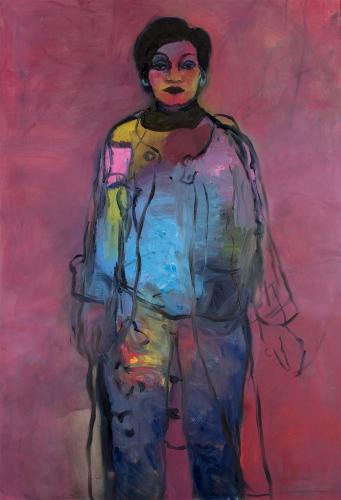
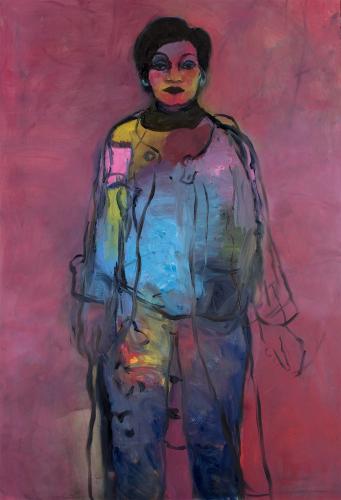
Work of the Week: "Making Faces" Heather Shillinglaw
This week’s Work of the Week is "Making Faces" by Métis artist Heather Shillinglaw.
In honour of Métis Week (November 15-21), this week’s Work of the Week is Making Faces by Métis artist Heather Shillinglaw.
About the Artist: Heather Shillinglaw
Heather Shillinglaw graduated in 1996 from the Alberta College of Art and Design (now the Alberta University of the Arts).
Her mixed-media work explores the bridging of cultures as she has experienced it as a Métis woman and as a traveler to other territories and countries. She is intrigued by the "similarities and differences" between cultures, something that her own heritage allows her to access more readily. In 1993, Heather partnered with National Film Board and Women of the Métis Nation using a film Daughter of the Country Series to create new works.
She is represented in numerous public, private and corporate collections and is an active member of several Métis organizations including Women of the Métis Nation. She has exhibited extensively around Alberta over the past ten years.
"Alberta and the Group of Seven" at Government House
Did you know there was a strong connection between Alberta and members of the Group of Seven?
Group of Seven.
Three words that thrill Canadian art lovers everywhere. And while much of the work produced by the Group of Seven focused on eastern Canada, did you know there was a strong connection between Alberta and members of the Group of Seven?
This connection is explored in an exhibition now on view at Government House in Edmonton. Aptly titled Alberta and the Group of Seven, it was developed by independent curator and writer Mary-Beth Laviolette in partnership with Gail Lint, Art Collections Consultant with the Arts Branch.
If this exhibition sounds familiar, a version of it, curated by Laviolette, travelled around Alberta from 2016 through 2018. The AFA Art Collection team installed the exhibition in Government House, made up of work from the Government House art collection, the collection of the Government of Alberta and the Alberta Foundation for the Arts art collection as part of our exhibition loan program. Click the arrows above to see a short slideshow of images of select artworks in the exhibition.
Click on an artist’s name to see their work in the AFA art collection.*

Artwork ready to be installed at Government House. Far right: Illingworth Kerr, "Forest Reserve, Spring". 1973. Oil on canvas. Collection of the Alberta Foundation for the Arts.
I had an opportunity to ask Mary-Beth Laviolette a few questions about this exhibition and the connection between Alberta and the Group of Seven.
AFA: What is the connection between Alberta and the Group of Seven?
MB: A number of early Alberta artists like H.G. Glyde and Catharine and Peter Whyte sketched and painted alongside members of the Group such as A.Y. Jackson and J.E.H. MacDonald. Jackson, for instance, did not drive, so artists like Glyde and members of the Lethbridge Sketch Club drove him to different sites to sketch or paint outdoors. Banff’s Peter and Catharine Whyte knew MacDonald and Lawren Harris from their outdoor excursions in the Rockies.

AFA Art Collections staff, Gail Lint and Jackie Flaata, install an artwork in Government House
AFA: Why do you think these artworks still have so much resonance today?
MB: First of all, they are memorable works of art. I mean, Euphemia McNaught’s oil of Monkman Creek simply glows, while Jackson’s small 1935 oil titled Foothills, Alberta captures so much of the distinctive character of the coulees. There are a lot of striking artworks from this period that are not only landscapes but also depictions of small-town Alberta and especially their grain elevators. Most of those [the grain elevators] are now gone and were not admired as artistic subjects at the time. Annora Brown of Fort Macleod was even advised in her own town there was nothing worthwhile to paint, and she should go to Europe where they had windmills, such as France! I guess there was a feeling that art happened somewhere else.

AFA Art Collections staff, Neil Lazaruk (left) and Duncan Johnson (right) install on Government House H.G. Glyde’s "Stream Under Grotto Mountain, Near Canmore". 1948. Oil on board. Collection of the Alberta Foundation for the Arts.
AFA: What do you want people to take away from this exhibition?
MB: There is such a thing called ‘Alberta art’, and it has a very fine legacy that connects into Canadian art. That may sound like an obvious thing to say, but it needs to be said.
AFA: How do these artworks fit into the story of Alberta art?
MB: They all do. For example, A.Y. Jackson’s 1943 painting of the newly constructed and remarkable Peace River Bridge was done at a time when the Alaska Highway was being built for reasons connected to the Second World War. H.G. Glyde, then of Calgary, accompanied him as an artist on this trip north.

Installed in Government House, Left: Euphemia McNaught’s "Monkman Creek". 1985. Oil on board. Collection of the Alberta Foundation for the Arts; Right: A.Y. Jackson’s "Peace River Bridge". 1943. Oil on panel. Collection of Government House.
AFA: Do you have a favourite artwork or artist in the exhibition?
MB: I have a lot of admiration for all of the early artists no matter where they were based, like Euphemia McNaught and Annora Brown. It’s good to know that next year Brown will be one of the artists featured in a national touring exhibition being organized by the McMichael Collection of Art in Kleinburg, Ontario in connection with the Group of Seven’s centenary. Everyone will be asking who is Annora Brown and where is Fort Macleod?
Interested in seeing these artworks and more in Government House? Free, guided tours take place on Sundays and holiday Mondays.
Mary-Beth Laviolette is an independent art writer and curator based in Canmore, Alberta. She specializes in Albertan and western Canadian art.
*Note: Two artworks mentioned in this article are not part of the AFA art collection. A.Y. Jackson's Peace River Bridge and Foothills, Alberta are in the art collection of Government House.
Written by: Kimberly Van Nieuvenhuyse, Writer/Social Media Officer
Did you know there was a strong connection between Alberta and members of the Group of Seven?
Now On View | Two New Emerging Curator Exhibitions
"Absence Inhabited" and "Dear Alan", featuring artworks from the AFA's collection, are now on view on Google Arts and Culture.
Absence Inhabited is curated by Ashley Slemming, and Dear Alan is curated by Natasha Chaykowski and Yasmin Nurming-Por. Both exhibitions have been generously funded though the Alberta Foundation for the Arts Emerging Curator Fellowship.
Absence Inhabited
This exhibition represents 29 artworks by 27 Alberta artists. These artists all highlight unique perspectives on object-hood and have contributed to a rich survey of domestically-situated artworks. These works ring into focus notions of intimate home spaces within a continually growing and interconnected relational world.
Curator's Statement (excerpt)
The works featured in this exhibition all tell different stories. The represented objects all appear to hold a patina or residue of life, yet all the objects presented are inanimate lifeless forms. Absence Inhabited consequently serves as an examination of absence representing presence and the inherent states of being that are reflected in these various artworks. The range of objects represented allows for consideration of the concept of home and being from a variety of viewpoints - and challenges us to think about how we live, communicate and function on a day-to-day basis.
Ashley Slemming, curator, Absence Inhabited
About the Curator: Ashley Slemming
Ashley Slemming is a Canadian embroidery and print artist based in Calgary, AB. Her work invites curiosity into our sentimental connection with repetition, pattern, and colour in both nature and textiles. In her conceptual art practice she often explores the parallels between human and animal behaviours that are revealed by our relationships to our living environments, both man-made and natural.
In addition to the AFA's Emerging Curator Fellowship, Ashley has explored curatorial avenues as a Curatorial Intern with the Illingworth Kerr Gallery. She has completed her BFA with distinction in Printmaking from the Alberta College of Art and Design.
Dear Alan
This exhibition represents 32 artworks by 31 Alberta artists.
Curators' Statement (excerpt)
Dear Alan brings together a dizzying number of landscapes from the AFA permanent collection, displayed in a digital gallery, salon style. Rather than present works within a cohesive curatorial theme, based on typical modes of exhibition-making that rely on continuities such as concept, form, or historical period, this exhibition seeks instead to show varied, and at times disparate, artistic approaches to landscape representation, across time and medium—a curatorial methodology that speaks to an impulse to approach art through a productive un-knowing, a state of wonder, that eschews the reliance upon expertise in a given area of research. Like the permanent collection itself, which in all institutions shifts and morphs with changing leadership, access to funds, and artistic vision, Dear Alan chronicles the ebbs and flows of the AFA’s ever-changing collecting ethos and the evolving artistic and political sensibilities in Alberta more broadly.
Natasha Chaykowski and Yasmin Nurming-Por, curators, Dear Alan
About the Curators: Natasha Chaykowski and Yasmin Nurming-Por
Natasha Chaykowski
Natasha Chaykowski is a writer and curator based in Calgary. Currently, she is Director of Untitled Art Society. She has organized numerous exhibitions, discursive programs and arts-based events. Chaykowski held a curatorial assistant position at Art Gallery of Ontario, co-curated the annual Emerging Artist Exhibition at InterAccess in Toronto with Nancy Webb and is the co-recipient of the 2014 Middlebrook Prize for Young Canadian Curators. She was Editorial Assistant for the Journal of Curatorial Studies and the Editorial Resident at Canadian Art magazine in 2014. Her writing has been published in Carbon Paper, the Art Gallery of York University, esse: arts + opinions, Canadian Art, Gallery 44, and the Journal of Curatorial Studies.
Yasmin Nurming-Por
Yasmin Nurming-Por is a curator, writer and educator currently based in Toronto, Ontario. In 2017, she was the recipient of the 5th Middlebrook Prize for Young Canadian Curators, and an Alberta Foundation. In addition to the Emerging Curator Followship exhibition, Dear Alan (co-curated with Natasha Chaykowski), 2018, other recent and upcoming projects include In shadows of the individual (2017); My curiosities are not your curios (2017); TV Dinner (2017); ARCTICNOISE (2015); At Sea(2015); and Blind White (2015). In 2015-2016 she was a sessional faculty member at Humber College in Toronto. In 2017 the position of Assistant Curator at the Walter Phillips Gallery at Banff Centre for Arts and Creativity, and currently holds the position of Research Assistant at the Art Gallery of Ontario.
Both exhibitions are available to view on Google Arts and Culture.
About the Emerging Curator Fellowship
This fellowship is designed to support the growth and development of curatorial talent by contracting an individual or ensemble of individuals to develop content for an online exhibition of Albertan visual art.
This initiative is intended to bring a new perspective to the artworks and artists featured in the AFA collection.
Jim Picco's Plastic Bag is part of the exhibition Absence Inhabited.
Alan's Untitled is part of the exhibition Dear Alan.
Work of the Week: World Art Day
We profile "World enough, and time" by Ken Macklin to help celebrate World Art Day on April 15.
Every year on April 15, World Art Day celebrates artistic creativity and promotes taking part in art.
"World enough, and time" by Ken Macklin is a meditation on the simultaneous nature of time. A skyward reaching column supports three spheres, representing the historic past, the complex present, and our collective hopes and dreams for the future.
- Translated into emotive colour, the past is expressed through earth tones that evoke the quietude and strength of the natural environment.
- The present is expressed through maroon-red and green, evoking the present concern for the environment, as well as denim blue to symbolize manual labour.
- The future, reaching towards both hope for humanity and awe for the greater context of the cosmos, is expressed through rich black, grey, blue, and silver.
As part of Canada's 150th anniversary, The Works International Visual Arts Society's Art & Design in Public Places Program (The Places) commissioned five original landmark sculptures along Capital Boulevard which lead to the Alberta legislature. This Project was made possible in part by the Government of Canada, with matching investments from partners: the Alberta Foundation for the Arts (AFA), and the City of Edmonton; and support from the Downtown Business Association, and The Works Society. In addition, all five sculptures were acquired as part of the AFA Art Collection.
- learn more about the Capital Boulevard Legacy Public Art Project - Canada 150
If you are in Edmonton, we encourage you to check out and marvel at the sculpture on Site 5, 108 Street between 103 Avenue and 104 Avenue. (You can also view it online using the button below.)
About the Artist:
Ken Macklin is one of several constructivist sculptors who emerged in Edmonton during the 1980s. Macklin earned his Bachelor of Fine Arts with Distinction from the University of Alberta in 1978 and studied advanced sculpture at St. Martins School of Art in London, England in 1979/80. He has exhibited both nationally and internationally, and has received numerous awards for his work. Macklin is renowned for the creation of large-scale, abstract sculptures.
Image description
The dark grey steel column sculpture supports three spirals. Each spiral steel with woven wire mesh has different colors - grey, blue and orange, red and green.
We profile "World enough, and time" by Ken Macklin to help celebrate World Art Day on April 15.
Work of the Week celebrates Lunar New Year
This week's Work of the Week is "Fortune Cookie" by Peter Greendale
Did you know Lunar New Year is celebrated by various cultures including Chinese, Korean, Vietnamese, and other East and Southeast Asian cultures? Every year, the date changes depending on the first new moon to mark the new year.
While each culture and ethnicity celebrates with differing foods, duration and traditions, each culture shares the same goal of reunion and well wishes of prosperity for the coming year. We hope the Year of the Tiger brings you a year full of good health, success and happiness!
About the artist:
Peter Greendale started his residency at the Banff Centre in 1984/85. He is inspired by the common everyday object and the culture's origin.
This week's Work of the Week is "Fortune Cookie" by Peter Greendale